

The global energy storage industry is evolving rapidly, and sodium-ion batteries are attracting growing attention as a potential complement to lithium-ion technology.
But as the industry moves beyond early research and development, a critical question remains: What will it take for sodium-ion batteries to achieve commercial success at scale?
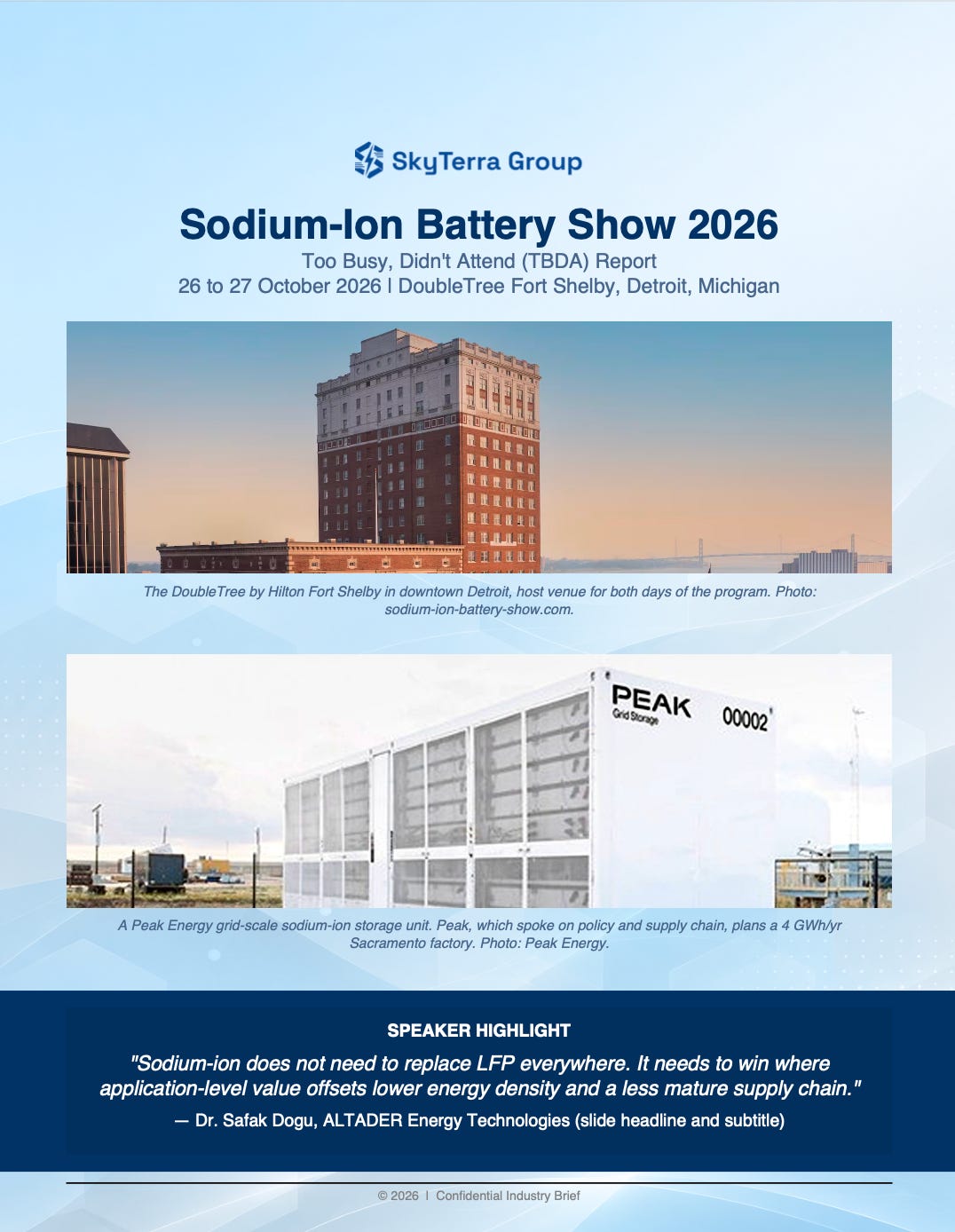
On October 26–27, 2026, industry leaders, researchers, manufacturers, and technology experts gathered in Detroit, Michigan, for the Sodium-Ion Battery Show 2026 to explore this question.
SkyTerra Group attended on behalf of SES AI, with Dr. Jonathan Scharf presenting on AI agents for battery development and participating in a panel discussion on scaling sodium-ion technology.
Our latest Too Busy, Didn’t Attend (TBDA) Report captures the key insights, technical developments, and industry perspectives from the event.
Where Sodium-Ion Technology Stands Today
Sodium-ion batteries offer potential advantages through the availability of sodium-based materials and opportunities to diversify battery supply chains.
However, industry discussions emphasized that sodium-ion technology is unlikely to replace lithium-ion batteries across every application.
Instead, its near-term opportunities appear strongest in specific markets, particularly stationary energy storage, 12V starter batteries, and potentially cold-weather applications.
According to FEV Consulting’s draft outlook presented at the event, sodium-ion batteries could account for approximately 4% of global battery energy storage system demand by 2030, increasing to 18% by 2050.
These projections highlight the technology’s potential while reinforcing the importance of application-specific performance and cost competitiveness.
How AI Is Accelerating Battery Research
One of the event’s key discussions focused on the growing role of artificial intelligence in accelerating battery innovation.
During his presentation on behalf of SES AI, Dr. Jonathan Scharf explored how AI agents can support battery research through integrated experimental design, materials discovery, testing, and performance forecasting.
SES AI presented examples demonstrating how AI-powered approaches can help researchers identify promising materials and reduce the number of experiments required during development.
In one study involving 53 electrolyte candidates, an AI model identified nine of the ten best-performing cells among its top 15 recommendations, representing a potential 72% reduction in the number of cells requiring testing.
These results were demonstrated using non-sodium-ion cells, with further validation needed for sodium-ion applications.
Nevertheless, the findings illustrate the potential of AI to make battery research more efficient and data-driven.
Key Challenges Facing Commercialization
Despite growing momentum, several challenges remain before sodium-ion technology can achieve widespread commercial adoption.
1. Materials and Manufacturing
Developing reliable hard-carbon anodes and sodium-specific separators remains essential for improving battery performance, consistency, and manufacturing scalability.
2. Supply Chain Development
Domestic manufacturing capabilities, access to suitable materials, and evolving trade policies will influence how sodium-ion supply chains develop, particularly in the United States.
3. Certification and Financial Viability
Industry experts emphasized that promising technology alone is not enough. Independent performance validation, safety certification, and customer qualification are critical to securing investment and commercial adoption.
4. Scaling Production
Moving from laboratory research to commercial manufacturing requires careful planning, disciplined engineering, and reliable production processes.
These challenges reinforce an important industry message: Commercial success will depend on demonstrated performance, manufacturing reliability, and economic viability, not simply technological potential.
What to Watch Over the Next 18 Months
The coming months will be an important period for sodium-ion technology.
Peak Energy is targeting production at its planned Sacramento facility in the first quarter of 2027, while CATL’s second-generation sodium-ion battery production is also expected to advance in 2027, according to information presented at the event.
Meanwhile, continued developments in battery materials, AI-driven research, domestic supply chains, and certification standards will help determine how quickly the technology progresses.
For the industry, the next stage will be defined increasingly by validated performance and successful commercial deployment.
Explore the Full SkyTerra TBDA Report
The Sodium-Ion Battery Show 2026 highlighted both the opportunities and practical challenges shaping the future of energy storage.
From AI-powered materials discovery to manufacturing scale-up and commercial readiness, the discussions underscored the importance of connecting scientific innovation with real-world applications.
At SkyTerra Group, we continue to follow developments at the intersection of artificial intelligence, energy, and critical infrastructure.
Our Sodium-Ion Battery Show 2026: Too Busy, Didn’t Attend (TBDA) Report provides a deeper look at the event’s presentations, technical findings, industry perspectives, and developments to watch.
Couldn’t attend the event? We’ve captured the key insights for you.
Read the full TBDA Report: https://www.skyterragroup.ai/news/#tbda
For more insights on AI, energy innovation, and emerging technologies, visit SkyTerra Group.
Subscribe to SkyTerra Group’s Substack for industry insights, research highlights, event recaps, and perspectives on the technologies shaping our future.