

The battery industry has spent years pursuing higher energy density.
The aerospace industry is asking a different question.
Can these batteries be trusted?
That distinction shaped much of the discussion at the NASA Battery Workshop, where engineers, researchers, and manufacturers focused less on incremental performance improvements and more on understanding why batteries fail, and how failures can be prevented before systems ever leave the factory.
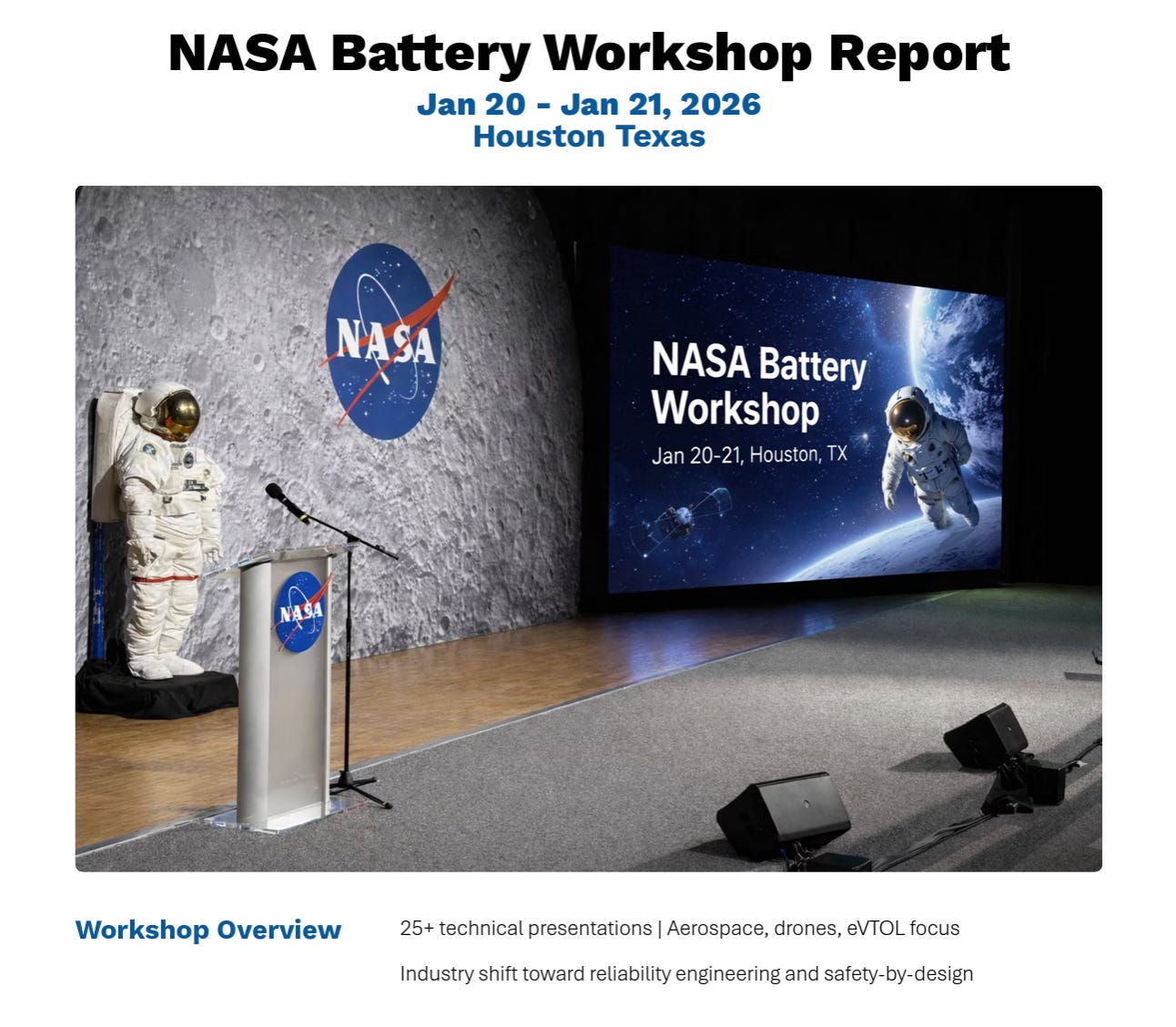
This represents an important evolution.
Historically, battery safety relied heavily on pack-level protection. Modern research is shifting that responsibility down to the cell itself through improved materials, passive safety mechanisms, and manufacturing quality.
The objective is straightforward: build batteries that fail safely or ideally, never fail at all.
Equally significant was the industry’s growing investment in inspection technologies.
Rather than relying on statistical sampling, manufacturers are increasingly exploring comprehensive screening using CT scanning, ultrasound, and advanced diagnostics capable of identifying microscopic defects before they become operational risks.
The philosophy is changing from detecting failures after production to preventing them during manufacturing.
Another notable trend is that qualification standards are expanding beyond laboratory performance.
Extreme temperatures, transportation stresses, long-duration storage, repeated cycling, and integration into increasingly complex systems are becoming central engineering challenges.
As batteries move into spacecraft, drones, advanced aviation, and autonomous platforms, reliability is no longer simply a technical objective. It becomes a mission requirement.
This reflects a broader transition occurring across critical infrastructure.
Performance remains important, but predictability, traceability, and system resilience increasingly determine whether technologies can scale into real-world deployment.
Innovation is becoming less about building the highest-performing battery, and more about building the most dependable one.
These are exactly the types of technology shifts SkyTerra follows across aerospace, energy storage, AI infrastructure, and advanced manufacturing. Understanding where engineering priorities are moving often provides a clearer signal than tracking performance metrics alone..
Please see the attached full copy of the TBDA article: NASA Aerospace Battery Workshop Report
If you’re looking to connect with others building across energy, AI, and infrastructure:
👉 Join the SkyTerra Network: https://dashboard.skyterragroup.org/apply-to-join
Stay connected:
LinkedIn: skyterragroup.org
Instagram: https://www.instagram.com/skyterragroup/
Facebook: https://www.facebook.com/Skyterragroup/
YouTube: https://www.youtube.com/@Sky-Terra
Website: https://www.skyterragroup.ai/
Newsletter: https://dashboard.skyterragroup.org/newsletter/subscribe