

The future of energy storage depends not only on developing better batteries but also on finding smarter, faster, and more scalable ways to bring new technologies to market.
As demand for reliable, affordable, and sustainable energy storage continues to grow, the industry is exploring new battery chemistries, manufacturing approaches, and digital technologies that can help address some of its most pressing challenges.
Among these emerging opportunities, sodium-ion batteries and artificial intelligence are gaining increasing attention for their potential to reshape how energy storage solutions are researched, developed, and commercialized.
At SkyTerra Group, we believe the intersection of AI, energy, and innovation presents an important opportunity to accelerate technological progress and build a more resilient energy future.
That is why we’re excited to announce that Jonathan Scharf will be speaking and participating in a panel discussion at the Sodium-Ion Battery Show 2026, representing SES AI through our partnership with SkyTerra Group.
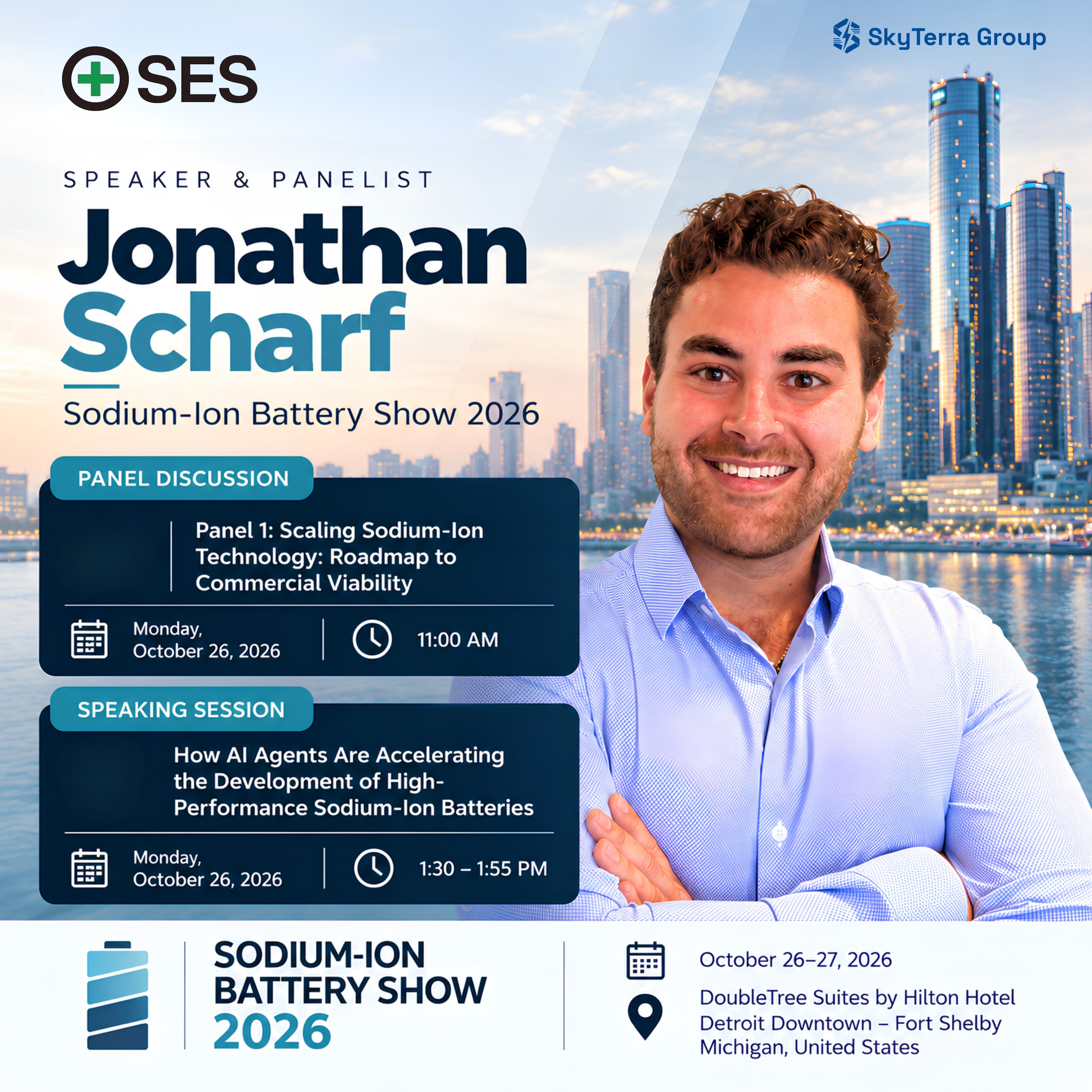
The event will take place October 26-27, 2026, in Detroit, Michigan, bringing together industry leaders, researchers, technology developers, and innovators working to advance the next generation of battery technologies.
Why Sodium-Ion Batteries Matter
As the energy transition continues, the need for energy storage technologies that can support expanding electricity demand, renewable energy integration, and grid resilience has become increasingly important.
Lithium-ion batteries have played a major role in advancing energy storage, but the industry is also exploring alternative chemistries that could provide additional flexibility in cost, materials, supply chains, and applications.
Sodium-ion batteries are one promising area of development.
Sodium is relatively abundant, and sodium-ion technology offers the potential to diversify battery supply chains while supporting applications where cost, safety, and scalability are important considerations.
However, moving from promising research to widespread commercial adoption requires overcoming significant challenges.
Battery developers must continue improving energy density, cycle life, performance, manufacturing consistency, and overall economics.
The challenge is not simply discovering better battery materials. It is accelerating the entire process of turning scientific innovation into commercially viable technology.
This is where artificial intelligence has the potential to make a meaningful difference.
How AI Agents Can Accelerate Battery Innovation
Traditional battery development often involves extensive experimentation, testing, and iterative adjustments to identify materials and chemical formulations that deliver the desired performance.
These processes can require substantial time, resources, and investment.
AI-driven approaches offer new ways to support researchers and engineers throughout the development process.
By combining predictive modeling, data analysis, simulation, and intelligent automation, AI agents can help identify promising material combinations and guide research toward more productive experiments.
Rather than relying exclusively on repeated trial-and-error testing, researchers can use AI to evaluate potential outcomes and prioritize the most promising directions.
Potential applications include:
Battery chemistry optimization: Identifying material combinations and formulations that may improve battery performance and stability.
Additive discovery: Exploring chemical additives that could enhance battery characteristics and support longer operational life.
Predictive modeling: Using existing experimental data to anticipate material behavior and guide future testing.
Development efficiency: Reducing unnecessary experimentation and helping researchers focus resources on higher-potential solutions.
Faster innovation cycles: Supporting more efficient transitions from early research toward validation and commercial development.
These capabilities do not eliminate the need for rigorous physical testing or scientific expertise. Instead, they provide additional tools that can help researchers make more informed decisions.
As AI technologies continue to evolve, their role in battery development could become increasingly valuable.
Jonathan Scharf to Speak on AI-Driven Sodium-Ion Battery Development
On Monday, October 26, from 1:30–1:55 PM, Jonathan Scharf will deliver a presentation titled:
How AI Agents Are Accelerating the Development of High-Performance Sodium-Ion Batteries
Representing SES AI through SkyTerra Group’s partnership, Jonathan will explore how AI agents can support the development of next-generation sodium-ion battery technologies.
The session will focus on the potential of AI-driven approaches to optimize battery chemistry, identify effective additives, and shorten development timelines through advanced predictive models and simulation.
Beyond the technical applications, the presentation will address a broader opportunity: how intelligent systems can help bridge the gap between scientific discovery and practical implementation.
For an industry working to improve performance while reducing development costs and accelerating commercialization, these capabilities could play an increasingly important role.
Scaling Sodium-Ion Technology: From Innovation to Commercial Viability
Developing a promising battery technology is only the beginning.
For sodium-ion batteries to achieve broader commercial adoption, the industry must address challenges involving manufacturing scale, supply chains, product reliability, market demand, and economic competitiveness.
These challenges require collaboration across research institutions, technology developers, manufacturers, investors, and other industry stakeholders.
On Monday, October 26, at 11:00 AM, Jonathan will also participate in:
Panel 1: Scaling Sodium-Ion Technology: Roadmap to Commercial Viability
Jonathan will join fellow panelists:
Jordan Arocha, Munro & Associates
John Wenfu Zhang, Exyte
The discussion will explore the opportunities and challenges associated with scaling sodium-ion technology and the practical considerations involved in moving from research and development toward commercial deployment.
Topics such as technological readiness, manufacturing capabilities, and commercialization pathways are central to the industry’s next stage of growth.
Bringing together different perspectives is essential to identifying solutions that can support sustainable, long-term progress.
Connecting AI, Energy, and Real-World Innovation
At SkyTerra Group, our work focuses on the intersection of artificial intelligence, energy, and critical infrastructure.
We see AI not simply as an emerging technology, but as a practical tool with the potential to help organizations solve complex problems, improve decision-making, and accelerate innovation.
Battery development represents one example of this broader opportunity.
As energy systems become more complex and demand for reliable power continues to increase, the ability to combine technical expertise with intelligent digital tools will become increasingly important.
Our partnership with SES AI reflects the value of collaboration in exploring how AI-driven innovation can support advances in energy storage technology.
Through industry engagement, technical discussions, and partnerships, we aim to contribute to conversations that move promising ideas closer to practical application.
Join Us in Detroit
We look forward to connecting with industry leaders, researchers, manufacturers, and innovators at the Sodium-Ion Battery Show 2026.
Event Details
Event: Sodium-Ion Battery Show 2026
Dates: October 26-27, 2026
Venue: DoubleTree Suites by Hilton Hotel Detroit Downtown - Fort Shelby, Michigan
Jonathan Scharf’s Sessions-Monday, October 26
11:00 AM- Panel Discussion
Scaling Sodium-Ion Technology: Roadmap to Commercial Viability
1:30-1:55 PM- Speaking Session
How AI Agents Are Accelerating the Development of High-Performance Sodium-Ion Batteries
We also extend our appreciation to the event organizers for bringing together industry professionals and creating opportunities for meaningful discussion and collaboration.
If you’re attending, we encourage you to connect with Jonathan and join the conversation about the future of sodium-ion technology and AI-powered battery innovation.
Follow SkyTerra Group for more insights on artificial intelligence, energy innovation, and the technologies shaping a more resilient tomorrow.